
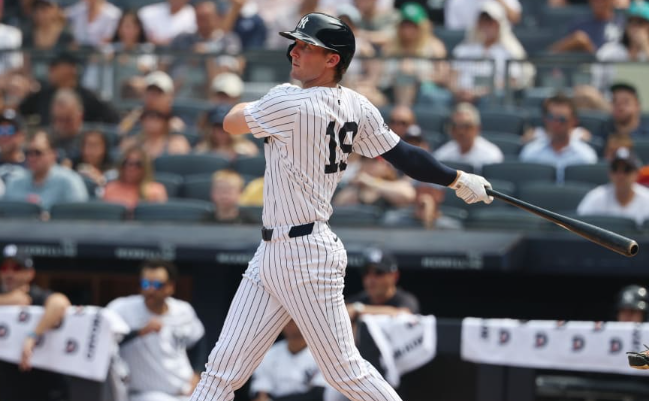
When the New York Yankees acquired third baseman Ryan McMahon from the Colorado Rockies on July 25, 2025, expectations were high. The 2024 All-Star, known for his consistent 20+ home run seasons and elite defensive skills, was seen as a solution to the Yankees’ third base woes. With a .217/.314/.403 slash line, 16 home runs, and 35 RBIs in 100 games with the Rockies, McMahon seemed poised to thrive in Yankee Stadium’s hitter-friendly confines, particularly with its short right-field porch. Yet, since joining the Yankees, McMahon’s power has vanished—he has yet to hit a home run in pinstripes. What’s behind this puzzling decline?
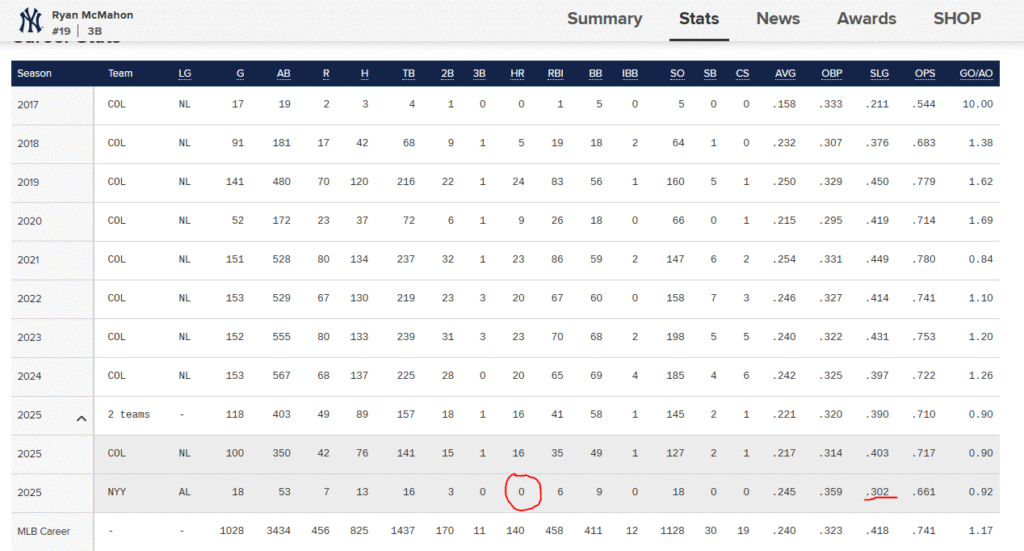
McMahon’s tenure with the Yankees began with promise. In his second game, he went 2-for-3 with a two-run double, helping secure a 4-3 win over the Philadelphia Phillies. His defensive prowess shone, with a sliding play that preserved a lead. However, his bat has since gone quiet, particularly in the power department. Through his first few weeks in New York, McMahon has failed to go deep, a stark contrast to his 10 home runs and .819 OPS in 39 games since June 7 with the Rockies.
One factor is the adjustment to a new environment. Moving from Coors Field, where the thin air boosts offensive numbers, to Yankee Stadium presents challenges. McMahon’s career road splits (.216/.664 OPS) are notably weaker than his home stats (.273/.818 OPS), suggesting difficulty adapting outside Denver’s unique conditions. While Yankee Stadium favors left-handed pull hitters like McMahon, his 18.8% pulled air-ball rate in 2025 hasn’t translated to homers, possibly due to mechanical adjustments or timing issues in a new ballpark.
Strikeouts are another concern. McMahon’s 32% strikeout rate this season, among the highest for qualifying third basemen, has carried over to New York. His aggressive approach, while yielding hard contact (93.6 mph average exit velocity, 98th percentile), often results in swings and misses. This high whiff rate may be exacerbated by facing tougher AL East pitching and the pressure of a playoff race, where pitchers exploit his tendency to chase.
The Yankees’ lineup context also plays a role. In Colorado, McMahon was often a focal point, but in New York, he bats lower in the order, typically sixth or seventh. While this reduces pressure, it also means fewer fastballs as pitchers navigate stars like Aaron Judge and Giancarlo Stanton. McMahon’s power relies on pulling fastballs, and seeing more off-speed pitches could be limiting his output.
Defensively, McMahon remains a standout, with 4 outs above average and Gold Glove-caliber metrics. His glove stabilizes the Yankees’ infield, but the lack of power raises questions about his offensive fit. At 30, with two years left on a $70 million contract, McMahon’s .728 OPS since joining isn’t disastrous, but it’s below expectations for a team needing offensive punch.
Could this be a temporary slump? McMahon’s underlying metrics—49.5% hard-hit rate, 12.1% barrel rate—suggest the power is still there. Adjustments to his approach, perhaps with the Yankees’ hitting coaches, could unlock his potential. For now, fans wait anxiously, hoping McMahon’s bat heats up before the postseason, where his defense alone would barely suffice.
BY: Adam King
Leave a Reply
You must be logged in to post a comment.