

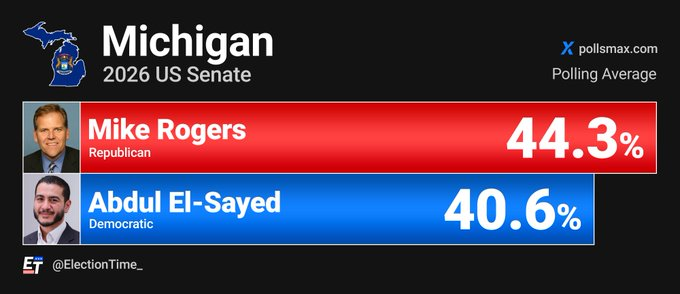
As the 2026 midterm cycle heats up, Michigan stands as a critical battleground where shifting political tides signal a potential Republican wave.
With Gary Peters (D) retiring from the U.S. Senate seat he has held since 2015, the open contest has transformed from a presumed Democratic hold into a prime pickup opportunity for the GOP. This race, is in a state that Donald Trump though narrowly carried in 2024. It is increasingly viewed as proof of broader momentum that could deliver massive gains for Republicans. Though at the same time major losses for Democratcsa this November.
Republicans have not won a U.S. Senate seat in Michigan since 1994, but the dynamics have changed dramatically. Trump’s victory in the state exposed vulnerabilities in the Democratic coalition. Without an incumbent advantage, Democrats face a messy August 4 primary. It features candidates like Rep. Haley Stevens, state Sen. Mallory McMorrow, and Dr. Abdul El-Sayed. Early polling shows a fragmented field with high undecideds, while raising concerns that the eventual nominee will emerge weakened and cash-strapped.
On the Republican side, former Rep. Mike Rogers leads comfortably. This benefits from significant outside support, including a major $45 million investment from a leading GOP group. Its the largest for any targeted pickup. Rogers, who came close in prior cycles, positions the race as a “change election,. He’s” tapping into voter frustration over the economy, border security, and cultural issues. Recent matchups show the contest as a toss-up or slight Democratic edge at best, but GOP strategists see a clear path to victory amid national headwinds for the president’s party.
A Republican flip here would be seismic. Democrats need net gains of multiple seats to challenge GOP control of the Senate (currently 53-47). Losing Michigan, an open seat in Trump-won territory—would severely damage those prospects, effectively ending realistic hopes of a chamber flip and underscoring Republican strength. Cook Political Report and others rate it a top GOP targe. With the race serving as a firewall against Democratic ambitions.
This Michigan contest is not an isolated issue for Democrats at all. It reflects national trends: strong GOP fundraising, while unified messaging on key voter priorities, and Democratic infighting. Similar dynamics play out in other battlegrounds, also suggesting Republicans are poised for substantial House and Senate gains. Midterms historically punish the party in power, and with inflation concerns, border issues, and policy fatigue lingering, the environment favors the opposition.Local signals reinforce this. A special election for Michigan’s 35th State Senate District on May 5 could provide an early indicator of turnout and sentiment in key regions. Broader control of statehouses and the U.S. House delegation already shows Republican inroads.
Analysts note that Michigan’s shift mirrors Rust Belt realignment. Working-class voters, including union households and even independents, have trended Republican in recent cycles. A victory for Rogers or his successor would validate this realignment while demoraliinge Democrats heading into the final stretch.In summary, the fight for Michigan’s open U.S. Senate seat exemplifies why Republicans are positioned for major wins in November. It combines favorable map dynamics, candidate strength, massive resource commitment, and underlying voter discontent. Far from a one-off, this race serves as a leading indicator of a potential red wave that could expand GOP majorities and reshape the political landscape for years to come.
SUMMERY: Conservatives see it as validation: the momentum is real, the map favors them, and November could deliver historic results. Democrats dismiss it at their peril.
BY: Adam King
Leave a Reply
You must be logged in to post a comment.